
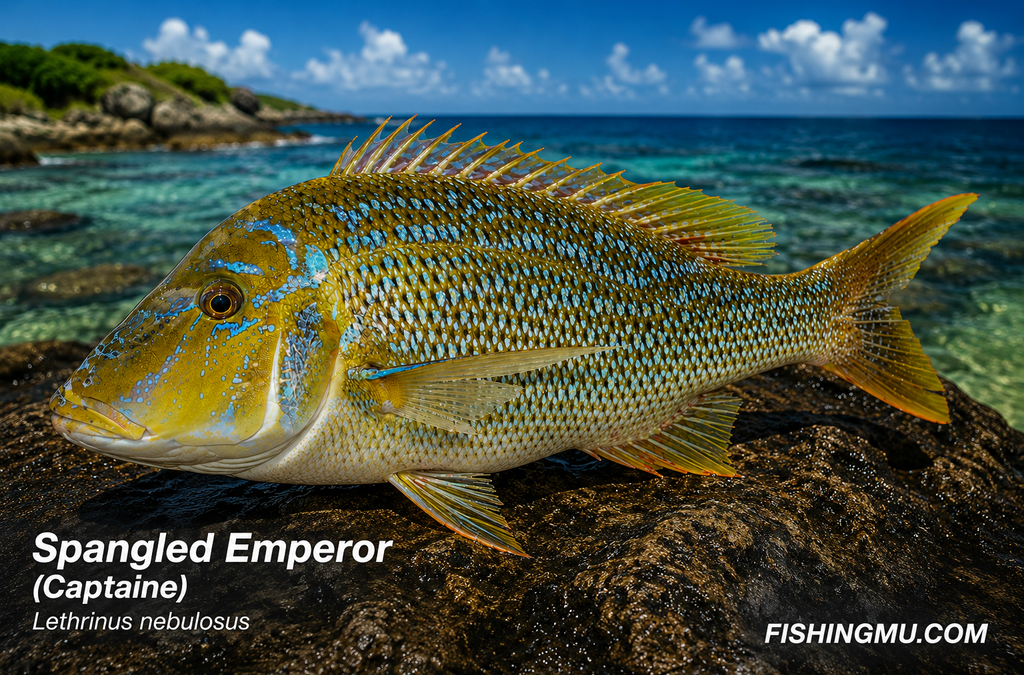
The Spangled Emperor, locally known in Mauritius as Captaine, is one of the prized reef fish sought by anglers around the island. Strong, cautious and excellent to eat, the Captaine is a popular target for both shore anglers and boat fishermen. It is commonly associated with rocky reefs, coral areas, sandy patches and other structures where it can find food and shelter.
For Mauritian anglers, targeting Captaine can be particularly rewarding because it requires more than simply casting a bait and waiting. Understanding the fish’s habitat, feeding behaviour, tides and preferred baits can make a significant difference.
What is a Spangled Emperor?
The Spangled Emperor is a member of the Lethrinidae family, commonly known as emperors. Its scientific name is Lethrinus nebulosus.
It has a robust, elongated body with a relatively large head and strong jaws. Its coloration can vary depending on its environment and mood, but it generally has a silvery, yellowish or brownish appearance with darker markings and numerous small spots or “spangles” across the body.
The fish is built for life around reefs and coastal structure. Its powerful mouth and teeth allow it to crush and consume hard-shelled prey such as crustaceans and molluscs, while it also feeds on smaller fish and other marine organisms.
In Mauritius, the name Captaine is commonly used by local fishermen for this type of emperor, although local fish names can sometimes vary from one region or fishing community to another.
Where to Find Captaine in Mauritius
Spangled Emperor are strongly associated with reef and bottom structure. When fishing around Mauritius, look for areas where different types of habitat meet.
Good areas can include:
- Coral reefs
- Rocky bottoms
- Reef edges
- Sandy patches between rocks
- Drop-offs
- Channels
- Areas around underwater structures
- Deep reef flats
- Coastal rocky areas
One of the most important things to understand is that Captaine do not necessarily stay directly on top of the reef. They may move between reef structure and nearby sandy or rocky areas while searching for food.
This makes reef edges and transitions particularly interesting.
A sandy patch beside a rocky reef, for example, can be much more productive than a completely uniform sandy bottom.
When Is the Best Time to Fish for Captaine?
Tides can have a major influence on bottom fishing.
Many anglers find that periods when water is moving can be productive because tidal currents transport food and encourage fish to become more active.
The beginning of a rising tide and periods around changes in current can be worth testing. However, the best tide can vary considerably depending on the location.
Rather than following a single rule, experienced anglers often keep records of:
- Tide height
- Current direction
- Moon phase
- Time of day
- Water clarity
- Wind
- Successful fishing spots
Over time, these records can reveal patterns specific to a particular fishing location.
Early morning and late afternoon can also be productive periods, particularly when fishing shallower reef areas.
Best Baits for Captaine
Natural bait is one of the most effective ways to target Spangled Emperor.
Because Captaine naturally feed around the bottom, fresh bait presented close to the seabed is often an excellent choice.
Squid
Squid is one of the most versatile baits for reef fishing.
Fresh squid can be cut into strips and attached securely to the hook. A strip that moves naturally in the current can be very attractive to bottom-feeding fish.
Squid is also relatively tough, allowing it to remain on the hook after smaller fish attack it.
Fish Fillets
Fresh fish can also be highly effective.
Small strips or chunks of locally available baitfish can be used depending on the size of the target fish.
A strip of fish with some skin attached can be particularly useful because the skin helps keep the bait on the hook.
Whole Small Fish
When targeting larger predators, a small whole baitfish can be presented naturally near the bottom.
The bait should be appropriately sized for the target fish and securely hooked.
Crab and Crustaceans
Crustaceans are an important part of the natural diet of many emperor species. Where legally permitted and locally available, suitable crustacean baits can be effective.
Always check local fishing regulations before collecting or using marine organisms as bait.
Bottom Fishing Techniques
One of the simplest and most effective approaches is bottom fishing.
The basic idea is to place the bait close to the seabed while allowing it to move naturally with the current.
A typical setup consists of:
Main line → leader → sinker → hook
The exact arrangement depends on the depth, current and type of bottom.
In strong current, a heavier sinker may be required to keep the bait close to the desired area. In lighter current, using a lighter weight can give the bait a more natural presentation.
Avoid using unnecessarily heavy tackle. A sensitive setup allows you to detect subtle bites and makes fighting the fish much more enjoyable.
Reading the Bite
Captaine can sometimes pick up a bait cautiously rather than immediately swallowing it.
This is why anglers should pay attention to changes in line tension.
You may initially feel:
tap… tap… pause
rather than a violent strike.
Allowing the fish a moment to take the bait can sometimes produce better hook-ups. However, fishing directly over rocks also creates a different problem: once hooked, the fish may immediately try to reach structure.
This is where good drag control and strong leader material become important.
Lure Fishing for Captaine
Although natural bait is extremely popular, artificial lures can also be used.
Bottom-oriented lure fishing can be particularly interesting around reefs and drop-offs.
Soft Plastics
Soft plastics can imitate small fish, shrimp or other prey.
Try fishing them close to the bottom with:
- Short hops
- Slow lifts
- Controlled drops
- Occasional pauses
The key is maintaining contact with the area where the fish are feeding without constantly getting snagged.
Jigs
Small to medium-sized metal jigs can be effective around deeper reefs and stronger currents.
A jig can be worked vertically from a boat or cast toward reef edges from shore.
Instead of retrieving at maximum speed, experiment with a slow or medium retrieve combined with pauses and short lifts.
Sinking Minnows
Sinking minnows can be useful when Captaine are actively hunting above the bottom.
Cast beyond the target area, allow the lure to sink and then retrieve it close to structure.
Care is required around rocky ground because sinking lures can become expensive casualties if they are allowed to remain on the bottom too long.
Tackle for Captaine
The ideal tackle depends heavily on whether you are fishing from shore or boat.
For general shore fishing, a medium-heavy spinning setup can provide a good balance between casting distance, sensitivity and power.
A typical setup could include:
- Medium-heavy spinning rod
- 4000–8000 size spinning reel
- Braided main line
- Fluorocarbon or abrasion-resistant leader
- Strong hooks
- Appropriate sinker or lure
Around extremely rough reef, stronger tackle may be necessary because the fish can use rocks and structure to cut the leader.
The important thing is to match the tackle to the size of fish, depth, current and structure rather than simply using the heaviest equipment available.
Fighting a Captaine
Once hooked, keep the fish under control.
If you are fishing around rocks, the first few seconds can be critical. Maintain enough pressure to prevent the fish from reaching heavy structure, while avoiding excessive drag that could cause the hook, leader or line to fail.
Once the fish is away from the immediate structure, you can gradually reduce pressure and enjoy the fight.
A quality leader is particularly important when fishing around sharp rocks and coral.
Respect the Reef and Fishery
Mauritius has valuable marine ecosystems, and responsible fishing is important for keeping these fisheries productive.
Anglers should respect:
- Minimum legal sizes
- Closed seasons or protected areas
- Bag limits
- Marine protected areas
- Local fishing regulations
When keeping fish for food, take only what you need.
If releasing a fish, handle it carefully and return it to the water as quickly as possible. Avoid placing fish unnecessarily on dry, abrasive surfaces.
Final Thoughts
The Spangled Emperor (Captaine) is a fantastic target for Mauritian anglers. Its combination of strength, caution and excellent table qualities makes it a rewarding fish to pursue.
The most important lesson is to fish the structure rather than simply fishing the water. Look for reef edges, sandy patches, drop-offs and areas where currents bring food together.
Start with fresh squid, fish strips or other suitable natural baits when learning the area. Once you understand where the fish feed, experiment with soft plastics, jigs and sinking lures.
Pay attention to tides, current, depth and bottom composition, and keep notes about successful sessions. Over time, these observations can turn a random fishing trip into a much more consistent strategy.
Whether you are fishing from the rocks around Mauritius or dropping a bait from a boat over deeper reef, targeting Captaine is an excellent way to experience the island’s rich marine fishing.
Tight lines and good fishing! 🎣
FishingMU.com — Your Ultimate Fishing Guide in Mauritius.
Comments